In many war games, conflict begins on the battlefield.
The armies are already assembled. The frontlines are already drawn. The player’s job is to command, charge, flank, break the enemy, and watch the outcome unfold over a few intense minutes of combat. What came before that battle — how the army was fed, where the weapons came from, whether the city could survive after its workers were pulled into military service — is often abstracted away.
Mandate Order takes a different approach.
Here, war begins much earlier.
It begins with whether a single well can support a growing population. It begins with whether a field can produce enough grain before winter. It begins with whether a warehouse is too far from a workshop, whether the armory actually holds enough weapons, and whether the wall you built before the enemy arrived is more than just a decorative boundary.
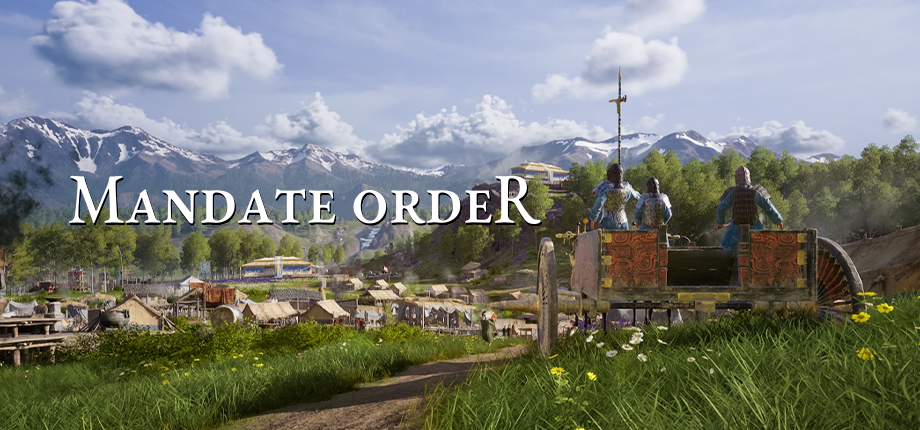
Mandate Order is an ancient Chinese war city-builder developed by Digital Sky, an independent studio based in Chengdu, China. Set against the backdrop of the Spring and Autumn and Warring States era, the game places players in charge of a fragile frontier settlement and asks them to turn it into a functioning military stronghold — one that can produce, govern, defend, mobilize, and eventually expand.
Players will build freely, manage resources, organize labor, maintain public order, develop logistics, cultivate farmland, recruit retainers from different philosophical schools, conduct diplomacy, and command large-scale battles. The result is a strategy simulation where city-building and warfare are not separate pillars, but two sides of the same system.
Mandate Order is currently listed on Steam, with the team planning to move toward its launch window in Q3 2026.
If recent city-builders have reminded players how compelling it can be to create order from nothing, Mandate Order asks a more specific historical question: in an age of fractured states, collapsing rituals, constant warfare, and competing philosophies, what does it actually take for a city to survive?

Before There Is an Empire, There Is a City Trying Not to Collapse
Mandate Order does not begin with an empire.
You are not handed a mature kingdom, a standing army, or a stable economy. The game begins with a piece of undeveloped land, a small population of laborers, and a settlement that exists more as a possibility than a city.
The first task is not conquest. It is survival.
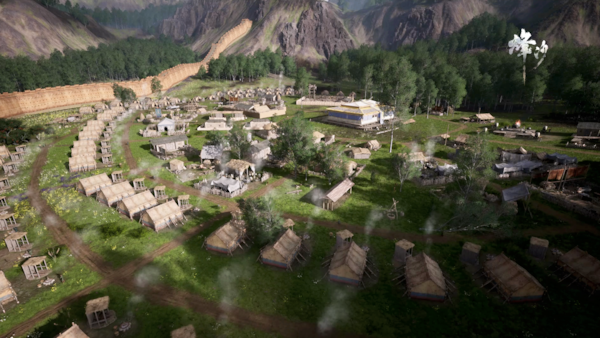
Housing provides shelter. Wells provide water. Fields produce food. Lumber camps and quarries supply basic construction materials. Workshops turn raw goods into tools and equipment. Warehouses store what the settlement needs. Roads determine how quickly goods can move. Barracks and armories make future military mobilization possible.
These are not isolated building buttons. Together, they form a living urban system. The placement of a warehouse affects the flow of materials. Road layouts affect how efficiently workers move. Production buildings depend on reliable supply chains. A poorly planned settlement may function at first, only to reveal its flaws once the city begins to grow.
Mandate Order uses freeform, gridless construction. Players can shape roads, districts, resource zones, and defensive lines around the terrain and their own priorities. The point is not simply to place buildings, but to understand that every act of expansion changes the city’s flow of labor, goods, and risk.
A city in Mandate Order is not something you decorate.
It is something you grow, strain, repair, and eventually defend.
Construction Is Not Decoration. It Is the First Half of War
One of Mandate Order’s central design ideas is that war should not be treated as a separate combat layer. Instead, war grows out of the city’s entire structure.
In this game, battle is not a spectacle that happens after the city-building is done. It is the test of everything the player has built before it.
Did you store enough food?
Did you preserve enough labor?
Can your workshops keep producing weapons?
Does your armory contain the equipment your soldiers need?
Can your roads move supplies to where they matter?
Is your wall simply surrounding the city, or does it form an actual defensive system?These questions determine whether a settlement can fight.
Early on, players focus on basic production: cutting wood, gathering stone, building shelters, opening farmland, setting up storage, and creating workshops. As the settlement grows, the nature of its problems changes. At first, the shortage is material. Later, it is transport capacity. At first, the problem is not having enough people. Later, it is having so many people that food, fuel, water, and housing become fragile.
Mandate Order is interested in the city not as a peaceful backdrop interrupted by war, but as a society gradually organizing itself for war.
This is where it separates itself from many conventional city-builders. The city is not a safe zone. The city is part of the battlefield.
Labor, Morale, and the “Wu”: A City Is Made of People, Not Just Numbers
Mandate Order uses “Wu” as its basic population unit. Each Wu represents a small group of laborers who gather, carry, build, produce, and maintain the settlement. Players do not micromanage every individual worker, but they do decide where labor should be assigned, which production chains should take priority, and which tasks can be delayed.
This makes the city feel less like a spreadsheet and more like a visible labor network.
Workers move timber, construct buildings, operate workshops, tend fields, haul supplies, and respond to the demands of the settlement. They need food, water, shelter, and fuel. They can be affected by illness, injury, weather, morale, and social instability. High morale can attract more people. Low morale can cause workers to leave — or even revolt.
Growth, therefore, is never purely positive.
A larger population means more hands, but also more mouths. Faster expansion increases logistical pressure. A broken production chain can quickly spread its consequences across the settlement.
Most importantly, laborers are not only a peacetime resource.
When enemies approach, workers can be conscripted into soldiers. But conscription does not magically create an army. Soldiers require weapons and equipment, and those goods must exist in the armory. In practical terms, raising troops means pulling labor out of the city’s daily economy and testing whether the settlement’s military preparation was sufficient.
That gives war a heavier cost. Sending workers to the frontline means some fields, workshops, construction sites, and transport tasks may slow down. Economic growth and military security are not separate meters. They are two pressures placed on the same fragile city.
Logistics Is Not a Background System. It Is Where the Mid-Game Lives
Many city-builders run into the same problem once a settlement becomes large: the challenge is no longer building more structures, but keeping the entire system coherent.
Mandate Order places that challenge inside its logistics.
Wood, stone, ore, grain, fuel, weapons, medicine, and siege equipment all need to be gathered, processed, stored, and delivered before they become usable. Players manage this flow through warehouses, freight stations, courier posts, and roads.
Freight stations handle longer-range resource transfer through supply and demand settings, while courier posts improve transport capacity by assigning labor specifically to logistics work. As the city expands, players may no longer be managing a single compact settlement, but a wider network of resource points, satellite locations, and defensive zones.
This makes the mid-to-late game less about placing more buildings and more about designing a functioning resource network.
Should food be stored centrally or distributed across the city?
Should the armory sit near production, or closer to the defensive line?
How do copper and iron from distant mines reliably reach weapon workshops?
Which transport route is most vulnerable if an invasion begins?
If winter fuel runs short, could internal unrest become more dangerous than the enemy army?In Mandate Order, a city is not a static arrangement of buildings. It is an economy in motion. Logistics determines whether agriculture, military production, public order, and expansion can support one another — and whether the city can survive when war finally arrives.
Spring Plowing, Summer Tending, Autumn Harvest, Winter Storage
The world of Mandate Order does not stand still. Seasons and weather affect not only the atmosphere of the game, but also agriculture, movement, resources, and the rhythm of city management.
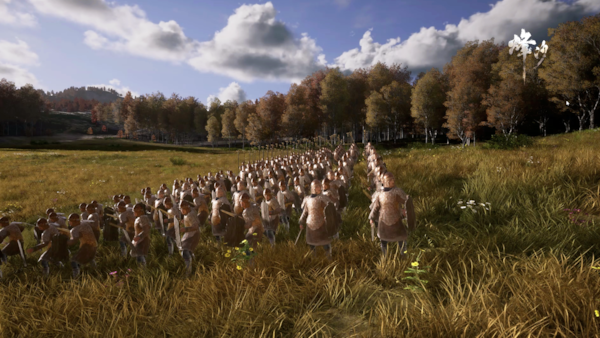
Farming is the base of stability. Players open fields, assign labor, manage cultivation, irrigation, maintenance, and harvest. Farmland has fertility, and repeated planting, crop choices, and long-term soil management all affect production. A harvest is not a simple output number; it is the result of planning, labor, water access, timing, and seasonal rhythm.
The agricultural cycle of spring plowing, summer tending, autumn harvest, and winter storage gives the game a distinctly agrarian sense of time.
Whether autumn grain is enough will determine how safely the city enters winter.
Whether winter fuel is prepared will determine whether morale collapses.
Whether population grows too quickly may decide whether food reserves survive the year.
Whether the army is expanded too early may affect the labor left for farming.The game also includes disasters and social crises. Meteor strikes, tornadoes, plague, disease, injuries, and rebellion can disrupt the player’s plans and force an immediate reallocation of labor, supplies, and priorities. A plague can spread. Injured workers and soldiers require treatment. Low morale can turn into unrest.
The enemies in Mandate Order are not only outside the walls. They are also time, weather, disease, hunger, and the fragility of social order.
Walls Are Not Borders. They Are the Final Test of City-Building
One of Mandate Order’s clearest points of difference is the way it places fortifications and combat at the center of the building loop.
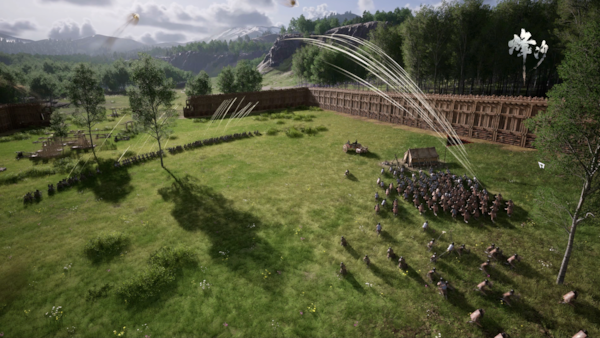
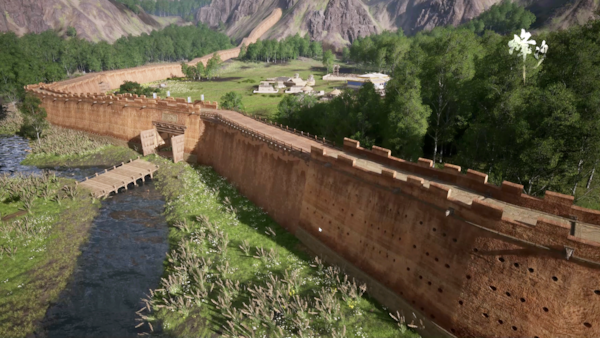
Players can design walls, gates, towers, and defensive lines, then station troops along the ramparts and install defensive equipment. A wall is not a visual edge around the city. It is a military structure that must function when the enemy arrives.
Elevation matters. Defenders on walls can gain positional advantages, while attackers fighting from below face disadvantages. Players must think about gates, breaches, towers, defensive equipment, and enemy approach routes as part of the same defensive problem.
On the battlefield, Mandate Order supports large-scale combat with units such as halberdiers, shield troops, archers, and chariot soldiers, alongside siege and defensive equipment such as ballistae and catapults. Chariots are one of the game’s most distinctive battlefield elements, built around impact, disruption, and formation-breaking momentum.
To make large-scale command more manageable, the game uses a line-drawing formation system. Players can select troops and draw lines on the terrain to create formations, issue movements, and execute defensive, offensive, flanking, or encircling maneuvers. Rather than relying only on unit-by-unit micromanagement, the system aims to give players a stronger sense of commanding an entire battle line.
Combat in Mandate Order is not an extra mode attached to the city-builder. It is the final exam of the city itself.
If food is short, the army cannot last.
If equipment is missing, conscription fails.
If roads are poorly planned, deployment slows.
If the wall is weak, the enemy will tear it open.
If the defensive line is badly designed, the battle will expose every mistake made before the fighting began.War does not appear suddenly. It reveals the truth of the settlement.
The Hundred Schools of Thought Are Not Background Lore. They Are Systems
Mandate Order does not want ancient Chinese culture to function merely as a visual skin. One of the defining features of the Spring and Autumn and Warring States era was the rise of competing philosophies — schools of thought that tried to answer practical questions about governance, war, agriculture, order, punishment, diplomacy, and survival.
Mandate Order turns that idea into its retainer system.
Players can recruit retainers associated with different schools, including Confucianism, Daoism, Mohism, Legalism, Military Strategy, Agriculturalism, Jiran, and Yin-Yang thought. These retainers are not just background characters with passive bonuses. They influence governance, production, military development, diplomacy, state policy, and long-term strategy.
Agriculturalist retainers may strengthen food production and survival. Legalist retainers may improve order and administrative efficiency. Mohist retainers naturally connect with defense, engineering, and production. Military strategists can alter how the settlement prepares for war.
The system is designed to make each playthrough less dependent on a fixed optimal build order. Who you recruit can influence what kind of city you build. Which schools you lean toward can change how you handle growth, war, diplomacy, and internal stability.
From a design perspective, this is also how Mandate Order tries to solve a common problem in historical games: how do cultural elements become gameplay rather than encyclopedia entries?
The game’s answer is: make the mechanic work first, then let the culture explain why it belongs.
The retainer system could be described as a hero system, an advisor system, or a talent system. But in the context of ancient China, the Hundred Schools of Thought gives that structure a more natural historical and thematic foundation.
Diplomacy, Rank, and Kingship: The World Beyond the Walls
Mandate Order does not take place only inside the city. As the settlement grows, players encounter diplomacy, trade, tribute, bribery, military support, retainer recruitment, and rank progression.
The diplomacy system allows players to form different relationships with other powers. Favor affects trade, cooperation, and the possibility of support. Players may pursue alliances, truces, commerce, tribute, or covert pressure depending on their situation. Retainers, policy direction, and the broader military landscape can all influence how diplomacy unfolds.
The rank system represents the settlement’s movement from a local power toward a greater political position. Population, morale, resources, buildings, and wealth can all become requirements for advancement. As the player moves closer to kingship, the game’s focus shifts from simply keeping one city alive to facing a larger political and military world.
The long-term objective, then, is not only to make a city bigger. It is to move from survival to governance, from defense to expansion, from a settlement under pressure to a possible new center of order.
The first question is whether the city can survive.
Only after that does the next question emerge: should it become something more?The First 10 Minutes, 2 Hours, and 5 Hours
The core loop of Mandate Order can be described as: identify a problem, plan construction, move resources, receive feedback.
In the first 10 minutes, the game aims to establish basic intuition. What am I building? What am I missing? Why is this building not working? Why are workers not carrying materials? Why do food, water, housing, and morale matter?
Around the 2-hour mark, players begin to shift from “knowing how to build” to “knowing how to manage.” The game becomes less about placing structures and more about understanding relationships: population growth versus food production, military security versus economic development, production efficiency versus transport distance, wall construction versus resource reserves.
After 5 hours, players may begin setting their own goals. Building a more beautiful city. Creating a more stable logistics network. Training a larger army. Surviving a stronger invasion. Testing a different retainer combination or policy direction.
This is where deeper simulation games often become most compelling. The system does not give players a single answer. It gives them problems, pressure, consequences, and room to develop their own style of city.
Not an “Eastern Manor Lords,” but an Eastern War City-Builder
Because Mandate Order combines freeform city-building, settlement management, and warfare, comparisons to games such as Manor Lords are inevitable. The team does not avoid that comparison, and openly acknowledges that strong city-builders have influenced its early settlement experience.
But Mandate Order does not aim to remain “an Eastern Manor Lords.”
Its real differences lie in where the game goes after that first impression: the retainer system, the Hundred Schools of Thought, the political atmosphere of the Warring States era, ancient fortress construction, siege and defense, chariots and war machines, logistics networks, diplomacy, rank progression, and the larger historical fantasy of becoming a power in a fractured world.
If Manor Lords draws much of its appeal from medieval settlement life under military pressure, Mandate Order is trying to offer a different experience: what it means to build a city in an ancient Chinese war context, where agriculture, philosophy, defense, labor, and statecraft are all tied together.
It is not simply a familiar city-builder with a different visual theme. It is an attempt to reinterpret city-building through the logic of ancient Chinese war, agriculture, governance, and social order.
The Development Challenge: Making Complexity Understandable
For a system-heavy simulation game, Mandate Order’s greatest challenge is not simply adding more features. It is making sure those features can be understood.
Complexity only becomes depth when players can read cause and effect, diagnose problems, adjust their plans, and see better results. Otherwise, complexity becomes confusion.
That is why much of the team’s current work focuses on clarity and iteration.
During previous public tests and demo periods, players pointed out issues such as insufficient onboarding, systems that were difficult to understand, high logistics complexity, performance problems, and stability concerns. In response, the team has been reworking tutorials, redesigning farming, adjusting conscription rules, improving armory logic, refining logistics feedback, strengthening UI prompts, and continuing performance optimization.
The goal is not to make the game shallow. It is to make the systems speak more clearly.
When food runs short, the player should be able to tell whether the problem is field planning, labor shortage, transport failure, or excessive population growth.
When conscription fails, the player should understand whether the issue is missing equipment, insufficient armory stock, or workers failing to reach the weapons in time.
When the city slows down, the player should be able to read the relationship between roads, warehouses, courier posts, freight stations, and labor assignment.
When a battle is lost, the player should understand that the defeat may have begun long before the enemy reached the wall.This kind of low-level iteration is less flashy than adding new content, but for a simulation game, it is what determines whether a complex system becomes playable, readable, and rewarding over time.
Why Mandate Order Is Worth Watching
Mandate Order is notable not only because it uses the Spring and Autumn and Warring States era, nor only because it combines city-building and warfare.
Its more interesting choice is perspective.
Instead of looking at war from the top of an empire, it begins with a city trying to survive. Instead of reducing battle to an isolated encounter, it connects war to farmland, warehouses, roads, labor, fuel, armories, walls, morale, and political order.
Every road affects the flow of resources.
Every reserve of grain may decide the safety of winter.
Every retainer can shift the direction of development.
Every wall will eventually be tested by war.Mandate Order is a game about war, but it does not rush the player onto the battlefield. It first asks the player to understand why a war can be fought at all, how a city can be defended, and how order slowly emerges in a time defined by disorder.
Perhaps its most compelling promise is not the scale of its battles, but everything that must happen before those battles become possible.
First, there is a well.
Then a field.
Then a granary.
Then a wall.
Only then does a city earn the right to face the smoke of war.Mandate Order is currently listed on Steam and supports 12 languages, including Simplified Chinese, Traditional Chinese, English, French, German, Turkish, Polish, Spanish, Brazilian Portuguese, Russian, Japanese, and Korean. The team is planning to move toward its launch window in Q3 2026.
Mandate Order:
Official website, Steam,Twitter, YouTube, Discord.
About Digital Sky™:
Mandate Order is being developed byDigital Sky, an independent studio based in Chengdu, with a team of just over 20 people working on the project.
For a team of that scale, the game is an ambitious undertaking. It combines city-building, resource logistics, worker AI, agriculture, seasons, weather, combat, fortification, retainers, diplomacy, localization, UI, and performance work. If any one of those systems becomes unclear, it affects how players understand the whole game.
The team is not presenting Mandate Order as a finished answer. More accurately, it is a game being repeatedly taken apart, rebuilt, and refined.
Through development logs, community feedback, and test builds, the team has continued to communicate with players and revise systems that once seemed settled. Praise is useful, but criticism often matters more, because it shows where players still expect the game to become better.
That gives Mandate Order a particular development identity. It is not a game carried by a single novelty. Its value will depend on sustained iteration — on whether the team can make the production, organization, defense, and warfare of an ancient city feel like one connected experience.
The armies are already assembled. The frontlines are already drawn. The player’s job is to command, charge, flank, break the enemy, and watch the outcome unfold over a few intense minutes of combat. What came before that battle — how the army was fed, where the weapons came from, whether the city could survive after its workers were pulled into military service — is often abstracted away.
Mandate Order takes a different approach.
Here, war begins much earlier.
It begins with whether a single well can support a growing population. It begins with whether a field can produce enough grain before winter. It begins with whether a warehouse is too far from a workshop, whether the armory actually holds enough weapons, and whether the wall you built before the enemy arrived is more than just a decorative boundary.
Mandate Order is an ancient Chinese war city-builder developed by Digital Sky, an independent studio based in Chengdu, China. Set against the backdrop of the Spring and Autumn and Warring States era, the game places players in charge of a fragile frontier settlement and asks them to turn it into a functioning military stronghold — one that can produce, govern, defend, mobilize, and eventually expand.
Players will build freely, manage resources, organize labor, maintain public order, develop logistics, cultivate farmland, recruit retainers from different philosophical schools, conduct diplomacy, and command large-scale battles. The result is a strategy simulation where city-building and warfare are not separate pillars, but two sides of the same system.
Mandate Order is currently listed on Steam, with the team planning to move toward its launch window in Q3 2026.
If recent city-builders have reminded players how compelling it can be to create order from nothing, Mandate Order asks a more specific historical question: in an age of fractured states, collapsing rituals, constant warfare, and competing philosophies, what does it actually take for a city to survive?
Before There Is an Empire, There Is a City Trying Not to Collapse
Mandate Order does not begin with an empire.
You are not handed a mature kingdom, a standing army, or a stable economy. The game begins with a piece of undeveloped land, a small population of laborers, and a settlement that exists more as a possibility than a city.
The first task is not conquest. It is survival.
Housing provides shelter. Wells provide water. Fields produce food. Lumber camps and quarries supply basic construction materials. Workshops turn raw goods into tools and equipment. Warehouses store what the settlement needs. Roads determine how quickly goods can move. Barracks and armories make future military mobilization possible.
These are not isolated building buttons. Together, they form a living urban system. The placement of a warehouse affects the flow of materials. Road layouts affect how efficiently workers move. Production buildings depend on reliable supply chains. A poorly planned settlement may function at first, only to reveal its flaws once the city begins to grow.
Mandate Order uses freeform, gridless construction. Players can shape roads, districts, resource zones, and defensive lines around the terrain and their own priorities. The point is not simply to place buildings, but to understand that every act of expansion changes the city’s flow of labor, goods, and risk.
A city in Mandate Order is not something you decorate.
It is something you grow, strain, repair, and eventually defend.
Construction Is Not Decoration. It Is the First Half of War
One of Mandate Order’s central design ideas is that war should not be treated as a separate combat layer. Instead, war grows out of the city’s entire structure.
In this game, battle is not a spectacle that happens after the city-building is done. It is the test of everything the player has built before it.
Did you store enough food?
Did you preserve enough labor?
Can your workshops keep producing weapons?
Does your armory contain the equipment your soldiers need?
Can your roads move supplies to where they matter?
Is your wall simply surrounding the city, or does it form an actual defensive system?These questions determine whether a settlement can fight.
Early on, players focus on basic production: cutting wood, gathering stone, building shelters, opening farmland, setting up storage, and creating workshops. As the settlement grows, the nature of its problems changes. At first, the shortage is material. Later, it is transport capacity. At first, the problem is not having enough people. Later, it is having so many people that food, fuel, water, and housing become fragile.
Mandate Order is interested in the city not as a peaceful backdrop interrupted by war, but as a society gradually organizing itself for war.
This is where it separates itself from many conventional city-builders. The city is not a safe zone. The city is part of the battlefield.
Labor, Morale, and the “Wu”: A City Is Made of People, Not Just Numbers
Mandate Order uses “Wu” as its basic population unit. Each Wu represents a small group of laborers who gather, carry, build, produce, and maintain the settlement. Players do not micromanage every individual worker, but they do decide where labor should be assigned, which production chains should take priority, and which tasks can be delayed.
This makes the city feel less like a spreadsheet and more like a visible labor network.
Workers move timber, construct buildings, operate workshops, tend fields, haul supplies, and respond to the demands of the settlement. They need food, water, shelter, and fuel. They can be affected by illness, injury, weather, morale, and social instability. High morale can attract more people. Low morale can cause workers to leave — or even revolt.
Growth, therefore, is never purely positive.
A larger population means more hands, but also more mouths. Faster expansion increases logistical pressure. A broken production chain can quickly spread its consequences across the settlement.
Most importantly, laborers are not only a peacetime resource.
When enemies approach, workers can be conscripted into soldiers. But conscription does not magically create an army. Soldiers require weapons and equipment, and those goods must exist in the armory. In practical terms, raising troops means pulling labor out of the city’s daily economy and testing whether the settlement’s military preparation was sufficient.
That gives war a heavier cost. Sending workers to the frontline means some fields, workshops, construction sites, and transport tasks may slow down. Economic growth and military security are not separate meters. They are two pressures placed on the same fragile city.
Logistics Is Not a Background System. It Is Where the Mid-Game Lives
Many city-builders run into the same problem once a settlement becomes large: the challenge is no longer building more structures, but keeping the entire system coherent.
Mandate Order places that challenge inside its logistics.
Wood, stone, ore, grain, fuel, weapons, medicine, and siege equipment all need to be gathered, processed, stored, and delivered before they become usable. Players manage this flow through warehouses, freight stations, courier posts, and roads.
Freight stations handle longer-range resource transfer through supply and demand settings, while courier posts improve transport capacity by assigning labor specifically to logistics work. As the city expands, players may no longer be managing a single compact settlement, but a wider network of resource points, satellite locations, and defensive zones.
This makes the mid-to-late game less about placing more buildings and more about designing a functioning resource network.
Should food be stored centrally or distributed across the city?
Should the armory sit near production, or closer to the defensive line?
How do copper and iron from distant mines reliably reach weapon workshops?
Which transport route is most vulnerable if an invasion begins?
If winter fuel runs short, could internal unrest become more dangerous than the enemy army?In Mandate Order, a city is not a static arrangement of buildings. It is an economy in motion. Logistics determines whether agriculture, military production, public order, and expansion can support one another — and whether the city can survive when war finally arrives.
Spring Plowing, Summer Tending, Autumn Harvest, Winter Storage
The world of Mandate Order does not stand still. Seasons and weather affect not only the atmosphere of the game, but also agriculture, movement, resources, and the rhythm of city management.
Farming is the base of stability. Players open fields, assign labor, manage cultivation, irrigation, maintenance, and harvest. Farmland has fertility, and repeated planting, crop choices, and long-term soil management all affect production. A harvest is not a simple output number; it is the result of planning, labor, water access, timing, and seasonal rhythm.
The agricultural cycle of spring plowing, summer tending, autumn harvest, and winter storage gives the game a distinctly agrarian sense of time.
Whether autumn grain is enough will determine how safely the city enters winter.
Whether winter fuel is prepared will determine whether morale collapses.
Whether population grows too quickly may decide whether food reserves survive the year.
Whether the army is expanded too early may affect the labor left for farming.The game also includes disasters and social crises. Meteor strikes, tornadoes, plague, disease, injuries, and rebellion can disrupt the player’s plans and force an immediate reallocation of labor, supplies, and priorities. A plague can spread. Injured workers and soldiers require treatment. Low morale can turn into unrest.
The enemies in Mandate Order are not only outside the walls. They are also time, weather, disease, hunger, and the fragility of social order.
Walls Are Not Borders. They Are the Final Test of City-Building
One of Mandate Order’s clearest points of difference is the way it places fortifications and combat at the center of the building loop.
Players can design walls, gates, towers, and defensive lines, then station troops along the ramparts and install defensive equipment. A wall is not a visual edge around the city. It is a military structure that must function when the enemy arrives.
Elevation matters. Defenders on walls can gain positional advantages, while attackers fighting from below face disadvantages. Players must think about gates, breaches, towers, defensive equipment, and enemy approach routes as part of the same defensive problem.
On the battlefield, Mandate Order supports large-scale combat with units such as halberdiers, shield troops, archers, and chariot soldiers, alongside siege and defensive equipment such as ballistae and catapults. Chariots are one of the game’s most distinctive battlefield elements, built around impact, disruption, and formation-breaking momentum.
To make large-scale command more manageable, the game uses a line-drawing formation system. Players can select troops and draw lines on the terrain to create formations, issue movements, and execute defensive, offensive, flanking, or encircling maneuvers. Rather than relying only on unit-by-unit micromanagement, the system aims to give players a stronger sense of commanding an entire battle line.
Combat in Mandate Order is not an extra mode attached to the city-builder. It is the final exam of the city itself.
If food is short, the army cannot last.
If equipment is missing, conscription fails.
If roads are poorly planned, deployment slows.
If the wall is weak, the enemy will tear it open.
If the defensive line is badly designed, the battle will expose every mistake made before the fighting began.War does not appear suddenly. It reveals the truth of the settlement.
The Hundred Schools of Thought Are Not Background Lore. They Are Systems
Mandate Order does not want ancient Chinese culture to function merely as a visual skin. One of the defining features of the Spring and Autumn and Warring States era was the rise of competing philosophies — schools of thought that tried to answer practical questions about governance, war, agriculture, order, punishment, diplomacy, and survival.
Mandate Order turns that idea into its retainer system.
Players can recruit retainers associated with different schools, including Confucianism, Daoism, Mohism, Legalism, Military Strategy, Agriculturalism, Jiran, and Yin-Yang thought. These retainers are not just background characters with passive bonuses. They influence governance, production, military development, diplomacy, state policy, and long-term strategy.
Agriculturalist retainers may strengthen food production and survival. Legalist retainers may improve order and administrative efficiency. Mohist retainers naturally connect with defense, engineering, and production. Military strategists can alter how the settlement prepares for war.
The system is designed to make each playthrough less dependent on a fixed optimal build order. Who you recruit can influence what kind of city you build. Which schools you lean toward can change how you handle growth, war, diplomacy, and internal stability.
From a design perspective, this is also how Mandate Order tries to solve a common problem in historical games: how do cultural elements become gameplay rather than encyclopedia entries?
The game’s answer is: make the mechanic work first, then let the culture explain why it belongs.
The retainer system could be described as a hero system, an advisor system, or a talent system. But in the context of ancient China, the Hundred Schools of Thought gives that structure a more natural historical and thematic foundation.
Diplomacy, Rank, and Kingship: The World Beyond the Walls
Mandate Order does not take place only inside the city. As the settlement grows, players encounter diplomacy, trade, tribute, bribery, military support, retainer recruitment, and rank progression.
The diplomacy system allows players to form different relationships with other powers. Favor affects trade, cooperation, and the possibility of support. Players may pursue alliances, truces, commerce, tribute, or covert pressure depending on their situation. Retainers, policy direction, and the broader military landscape can all influence how diplomacy unfolds.
The rank system represents the settlement’s movement from a local power toward a greater political position. Population, morale, resources, buildings, and wealth can all become requirements for advancement. As the player moves closer to kingship, the game’s focus shifts from simply keeping one city alive to facing a larger political and military world.
The long-term objective, then, is not only to make a city bigger. It is to move from survival to governance, from defense to expansion, from a settlement under pressure to a possible new center of order.
The first question is whether the city can survive.
Only after that does the next question emerge: should it become something more?The First 10 Minutes, 2 Hours, and 5 Hours
The core loop of Mandate Order can be described as: identify a problem, plan construction, move resources, receive feedback.
In the first 10 minutes, the game aims to establish basic intuition. What am I building? What am I missing? Why is this building not working? Why are workers not carrying materials? Why do food, water, housing, and morale matter?
Around the 2-hour mark, players begin to shift from “knowing how to build” to “knowing how to manage.” The game becomes less about placing structures and more about understanding relationships: population growth versus food production, military security versus economic development, production efficiency versus transport distance, wall construction versus resource reserves.
After 5 hours, players may begin setting their own goals. Building a more beautiful city. Creating a more stable logistics network. Training a larger army. Surviving a stronger invasion. Testing a different retainer combination or policy direction.
This is where deeper simulation games often become most compelling. The system does not give players a single answer. It gives them problems, pressure, consequences, and room to develop their own style of city.
Not an “Eastern Manor Lords,” but an Eastern War City-Builder
Because Mandate Order combines freeform city-building, settlement management, and warfare, comparisons to games such as Manor Lords are inevitable. The team does not avoid that comparison, and openly acknowledges that strong city-builders have influenced its early settlement experience.
But Mandate Order does not aim to remain “an Eastern Manor Lords.”
Its real differences lie in where the game goes after that first impression: the retainer system, the Hundred Schools of Thought, the political atmosphere of the Warring States era, ancient fortress construction, siege and defense, chariots and war machines, logistics networks, diplomacy, rank progression, and the larger historical fantasy of becoming a power in a fractured world.
If Manor Lords draws much of its appeal from medieval settlement life under military pressure, Mandate Order is trying to offer a different experience: what it means to build a city in an ancient Chinese war context, where agriculture, philosophy, defense, labor, and statecraft are all tied together.
It is not simply a familiar city-builder with a different visual theme. It is an attempt to reinterpret city-building through the logic of ancient Chinese war, agriculture, governance, and social order.
The Development Challenge: Making Complexity Understandable
For a system-heavy simulation game, Mandate Order’s greatest challenge is not simply adding more features. It is making sure those features can be understood.
Complexity only becomes depth when players can read cause and effect, diagnose problems, adjust their plans, and see better results. Otherwise, complexity becomes confusion.
That is why much of the team’s current work focuses on clarity and iteration.
During previous public tests and demo periods, players pointed out issues such as insufficient onboarding, systems that were difficult to understand, high logistics complexity, performance problems, and stability concerns. In response, the team has been reworking tutorials, redesigning farming, adjusting conscription rules, improving armory logic, refining logistics feedback, strengthening UI prompts, and continuing performance optimization.
The goal is not to make the game shallow. It is to make the systems speak more clearly.
When food runs short, the player should be able to tell whether the problem is field planning, labor shortage, transport failure, or excessive population growth.
When conscription fails, the player should understand whether the issue is missing equipment, insufficient armory stock, or workers failing to reach the weapons in time.
When the city slows down, the player should be able to read the relationship between roads, warehouses, courier posts, freight stations, and labor assignment.
When a battle is lost, the player should understand that the defeat may have begun long before the enemy reached the wall.This kind of low-level iteration is less flashy than adding new content, but for a simulation game, it is what determines whether a complex system becomes playable, readable, and rewarding over time.
Why Mandate Order Is Worth Watching
Mandate Order is notable not only because it uses the Spring and Autumn and Warring States era, nor only because it combines city-building and warfare.
Its more interesting choice is perspective.
Instead of looking at war from the top of an empire, it begins with a city trying to survive. Instead of reducing battle to an isolated encounter, it connects war to farmland, warehouses, roads, labor, fuel, armories, walls, morale, and political order.
Every road affects the flow of resources.
Every reserve of grain may decide the safety of winter.
Every retainer can shift the direction of development.
Every wall will eventually be tested by war.Mandate Order is a game about war, but it does not rush the player onto the battlefield. It first asks the player to understand why a war can be fought at all, how a city can be defended, and how order slowly emerges in a time defined by disorder.
Perhaps its most compelling promise is not the scale of its battles, but everything that must happen before those battles become possible.
First, there is a well.
Then a field.
Then a granary.
Then a wall.
Only then does a city earn the right to face the smoke of war.Mandate Order is currently listed on Steam and supports 12 languages, including Simplified Chinese, Traditional Chinese, English, French, German, Turkish, Polish, Spanish, Brazilian Portuguese, Russian, Japanese, and Korean. The team is planning to move toward its launch window in Q3 2026.
Mandate Order:
Official website, Steam,Twitter, YouTube, Discord.
About Digital Sky™:
Mandate Order is being developed byDigital Sky, an independent studio based in Chengdu, with a team of just over 20 people working on the project.
For a team of that scale, the game is an ambitious undertaking. It combines city-building, resource logistics, worker AI, agriculture, seasons, weather, combat, fortification, retainers, diplomacy, localization, UI, and performance work. If any one of those systems becomes unclear, it affects how players understand the whole game.
The team is not presenting Mandate Order as a finished answer. More accurately, it is a game being repeatedly taken apart, rebuilt, and refined.
Through development logs, community feedback, and test builds, the team has continued to communicate with players and revise systems that once seemed settled. Praise is useful, but criticism often matters more, because it shows where players still expect the game to become better.
That gives Mandate Order a particular development identity. It is not a game carried by a single novelty. Its value will depend on sustained iteration — on whether the team can make the production, organization, defense, and warfare of an ancient city feel like one connected experience.