Almost every city-builder begins with the same simple act: placing the first building.
A house. A well. A field. Then workshops, warehouses, and roads. An empty stretch of land slowly begins to take on the shape of a settlement.
It is one of the most satisfying experiences in the genre.
Every new structure makes the city feel more complete, more active, and more alive.
But as the game continues, many city-builders run into a similar problem:
The number of buildings keeps increasing, while the number of meaningful decisions does not always increase with them.
Once a building is completed, it often begins working automatically. The player continues unlocking new structures, new districts, and new production chains, while construction itself gradually becomes something that ends the moment a building is placed.
We have always felt that city-building can go one step further.
Because building a city should not only be about placing structures.
It should feel like governing one.
Real cities are never defined by a single building.
What truly determines how a city functions is the relationship between buildings.
Roads determine how people move.
Warehouses determine how resources move.
Residential districts determine how labor is distributed.
Farms determine where food comes from.
Armories determine how equipment becomes military power.
Defensive structures determine how the city responds when war arrives.
So the important question is not only:
What should I build next?
It is:
What will this building change?
Once players begin asking that question, construction stops being placement and starts becoming governance.
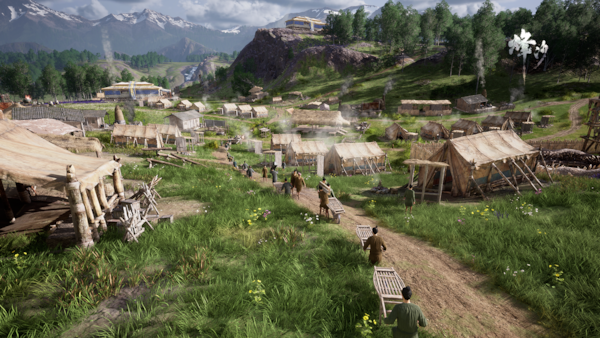
A Farm Is Not Finished the Moment It Is Placed
This is one of the design directions Mandate Order has been trying to explore.
The game does not treat buildings as isolated upgrades. Instead, it asks players to consider how every district supports the city around it.
Take farmland.
A field is not simply a building that steadily increases the food supply.
Its location affects its initial fertility. Cultivation consumes fertility, while leaving the land fallow allows it to recover. During the summer care phase, water, fertilizer water, and weeding all affect the expected autumn harvest. Where players place a field today determines how they will later organize water access, labor, roads, and storage around it.
That means a field is not an isolated production point.
It continues to change the city after it has been built.
If farmland is too far from a well, crop care may become less efficient.
If it is too far from a granary, transportation pressure increases during the harvest.
If too much farmland is opened at once, there may not be enough workers to maintain it during summer.
If the same land is continuously cultivated, fertility becomes a long-term concern.
Building a field, then, is not simply completing a task.
It means taking responsibility for a series of management decisions that may last for several months or even several seasons.
A Warehouse Determines Whether Resources Can Actually Be Used
Warehouses are not simply extra storage capacity either.
In Mandate Order, different buildings have different work ranges and storage requirements. The fact that a resource has been gathered does not mean every building can use it immediately.
Timber may already have been cut down, but still not delivered to a construction site.
Ore may already be stored, but remain outside the operating range of a workshop.
Weapons may already have been produced, but not yet delivered to the armory.
Because of this, warehouse location, storage rules, and the buildings it serves all affect the way the city functions.
A warehouse placed too far from a production district may leave workshops waiting for materials.
A granary that is poorly positioned in relation to fields and housing may hold food without circulating it efficiently through the city.
An armory placed far from both workshops and defensive positions may slow equipment delivery and wartime response.
This turns storage from a passive container into a distribution node.
When players build a warehouse, they are effectively deciding:
Which resources should be centralized, and which should be distributed?
Which districts require local supply?
Which production chains should be placed close together?
Which reserves need to be protected first?
Once buildings begin carrying these kinds of relationships, construction begins to feel like governance.
Roads Are Not Decoration. They Define How a City Operates
Roads follow the same principle.
In Mandate Order, players can adjust road width and curvature, and roads can also be upgraded. Upgraded roads allow workers to move more quickly.
That means roads do more than shape the appearance of a settlement. They directly affect resource transportation, construction speed, agricultural work, and troop movement during war.
A road that bends too far around a district may delay timber deliveries to a construction site.
Poor connections between production and storage areas may leave workshops idle.
Inefficient routes between fields, wells, and granaries can amplify transportation pressure during seasonal production.
The same roads that help workers carry materials during peacetime may later become the routes soldiers use to reinforce threatened defensive positions.
Building a road is therefore not simply a matter of connecting two structures.
It is a decision about how the city’s circulation will work.
A road placed casually in the early game may become a bottleneck later.
A well-planned main route, by contrast, may improve production, storage, and military movement at the same time.
A road may look like a line on the ground.
But it continues to affect almost every movement inside the city.
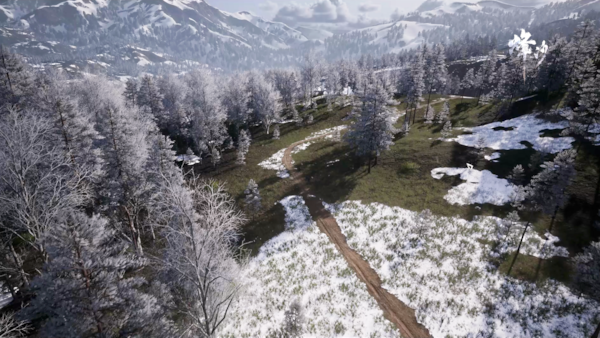
Residential Districts Determine How Labor Enters the City
Even the location of housing becomes a governance decision.
In Mandate Order, population is organized into units called Wu, with each Wu representing roughly five workers. These workers farm, haul resources, construct buildings, gather materials, and operate workshops. Buildings do not function automatically after placement. Players must assign Wu to them before regular work can begin.
This means population is not an abstract number.
Workers move through the city every day.
From housing to farmland.
From warehouses to workshops.
From resource deposits to construction sites.
From ordinary jobs to the armory and military rally points.
Where housing is located affects how much time workers spend traveling and how efficiently the city can distribute its limited labor force.
A larger population does not automatically create a more efficient city.
If housing, production, storage, and roads are poorly organized, additional population may instead create longer commutes, more complicated labor allocation, and greater management pressure.
Building a residential district is therefore not only about satisfying the need for shelter.
It also determines how labor enters every production chain in the city.
War Makes Every Construction Decision Visible Again
Once war arrives, the relationships between these buildings become even more obvious.
Many strategy games separate city management and warfare into two different systems.
One develops the economy.
The other produces armies.
The player simply switches from one mode of play to the other.
Mandate Order is designed to keep them connected.
The same workers who cultivate fields also haul materials, construct buildings, and produce equipment. When war comes, those same workers may be conscripted into military service.
Under the revised conscription rules, players cannot recruit soldiers without an armory. Only equipment physically stored inside the armory counts as available. Weapons still in transit, or lying in resource piles on the ground, cannot immediately be converted into military strength. Once a rally point is confirmed, conscripted workers stop their current tasks immediately, and any goods they are carrying are left behind.
This means war is not only a military system.
More soldiers at the front means fewer workers in the rear.
Workshop output may fall.
Farm maintenance may slow down.
Transportation may be interrupted.
Construction on defensive structures may stop.
Every road, warehouse, field, and district built during peacetime reveals its consequences once war begins.
War is not a separate layer suddenly placed over the city.
It is a concentrated test of all the construction decisions that came before it.
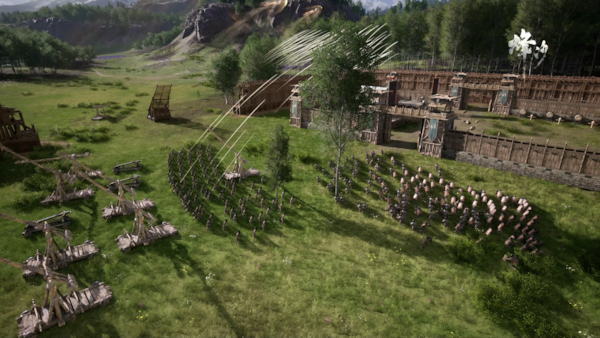
A Larger City Is Not Necessarily a Stronger City
This also changes what expansion means.
A larger city is not automatically a stronger city.
More districts create longer transportation routes.
More complex industries create greater storage and logistics pressure.
A larger population increases demand for food, water, fuel, housing, and employment.
A larger army removes more workers from the civilian economy.
Every expansion creates new governance problems.
Players cannot simply continue placing more buildings.
They must also return to the city they have already built and reorganize it.
Roads may need to be redesigned.
Storage networks may need to be redistributed.
The distance between housing and workshops may need to be reconsidered.
Some farmland may need to be left fallow.
The armory may need to be positioned closer to production districts, or closer to defensive lines.
The city keeps changing, so construction must continue changing with it.
At that point, building is no longer something that only happens at the beginning of the game.
It becomes an ongoing process of governance.
Why Mandate Order Is Designed This Way
This is the kind of experience Mandate Order is trying to explore.
In the world of the Spring and Autumn and Warring States era, a city could never survive through a single resource or system alone.
Farms determined food supply.
Roads connected production.
Warehouses maintained distribution.
Armories supported conscription.
Workers were responsible for farming, hauling, construction, and war.
When conflict arrived, what was tested was not only the army. It was the order the entire city had built over the previous months and seasons.
Mandate Order places city construction, resource management, and real-time tactical combat inside the same war city-building loop, rather than treating them as separate modules.
For that reason, the game does not treat construction as decoration.
Placing a building is not the end of a task.
It is another attempt to answer the same question:
How will this city function?
As population grows, logistics routes stretch, industries expand, and enemies approach, the relationships between buildings determine whether the city can continue producing, feeding its people, mobilizing troops, and defending itself.
For Mandate Order, that is what makes a war city-builder interesting.
Because what supports a war is not only the final wall raised around the settlement.
It is the entire city players have been building, step by step, from the first field, the first warehouse, and the first road.
A city is not ready for war simply because its walls are finished.
It is ready when everything behind those walls can already work together.
About Mandate Order
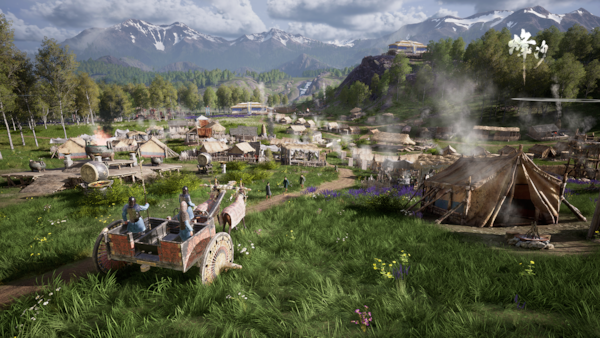
Mandate Order is an Eastern war city-building simulation developed by Digital Sky and set during China’s Spring and Autumn and Warring States era.
Players begin with a small frontier settlement and gradually construct homes, wells, farms, warehouses, workshops, barracks, armories, roads, walls, and defensive facilities, while balancing agriculture, production, public needs, logistics, retainers, diplomacy, conscription, and large-scale warfare.
The game features freeform construction, population management based on the Wu labor unit, dynamic seasons, retainers inspired by the Hundred Schools of Thought, armory-based conscription, line-drawing formations, and large-scale siege and defensive battles. Rather than presenting these as isolated systems, Mandate Order connects them within a single simulation of how a city prepares for and survives war.
Mandate Order is currently listed on Steam and is planned for release in the third quarter of 2026.
Steam
Official X
Official website
A house. A well. A field. Then workshops, warehouses, and roads. An empty stretch of land slowly begins to take on the shape of a settlement.
It is one of the most satisfying experiences in the genre.
Every new structure makes the city feel more complete, more active, and more alive.
But as the game continues, many city-builders run into a similar problem:
The number of buildings keeps increasing, while the number of meaningful decisions does not always increase with them.
Once a building is completed, it often begins working automatically. The player continues unlocking new structures, new districts, and new production chains, while construction itself gradually becomes something that ends the moment a building is placed.
We have always felt that city-building can go one step further.
Because building a city should not only be about placing structures.
It should feel like governing one.
Real cities are never defined by a single building.
What truly determines how a city functions is the relationship between buildings.
Roads determine how people move.
Warehouses determine how resources move.
Residential districts determine how labor is distributed.
Farms determine where food comes from.
Armories determine how equipment becomes military power.
Defensive structures determine how the city responds when war arrives.
So the important question is not only:
What should I build next?
It is:
What will this building change?
Once players begin asking that question, construction stops being placement and starts becoming governance.
A Farm Is Not Finished the Moment It Is Placed
This is one of the design directions Mandate Order has been trying to explore.
The game does not treat buildings as isolated upgrades. Instead, it asks players to consider how every district supports the city around it.
Take farmland.
A field is not simply a building that steadily increases the food supply.
Its location affects its initial fertility. Cultivation consumes fertility, while leaving the land fallow allows it to recover. During the summer care phase, water, fertilizer water, and weeding all affect the expected autumn harvest. Where players place a field today determines how they will later organize water access, labor, roads, and storage around it.
That means a field is not an isolated production point.
It continues to change the city after it has been built.
If farmland is too far from a well, crop care may become less efficient.
If it is too far from a granary, transportation pressure increases during the harvest.
If too much farmland is opened at once, there may not be enough workers to maintain it during summer.
If the same land is continuously cultivated, fertility becomes a long-term concern.
Building a field, then, is not simply completing a task.
It means taking responsibility for a series of management decisions that may last for several months or even several seasons.
A Warehouse Determines Whether Resources Can Actually Be Used
Warehouses are not simply extra storage capacity either.
In Mandate Order, different buildings have different work ranges and storage requirements. The fact that a resource has been gathered does not mean every building can use it immediately.
Timber may already have been cut down, but still not delivered to a construction site.
Ore may already be stored, but remain outside the operating range of a workshop.
Weapons may already have been produced, but not yet delivered to the armory.
Because of this, warehouse location, storage rules, and the buildings it serves all affect the way the city functions.
A warehouse placed too far from a production district may leave workshops waiting for materials.
A granary that is poorly positioned in relation to fields and housing may hold food without circulating it efficiently through the city.
An armory placed far from both workshops and defensive positions may slow equipment delivery and wartime response.
This turns storage from a passive container into a distribution node.
When players build a warehouse, they are effectively deciding:
Which resources should be centralized, and which should be distributed?
Which districts require local supply?
Which production chains should be placed close together?
Which reserves need to be protected first?
Once buildings begin carrying these kinds of relationships, construction begins to feel like governance.
Roads Are Not Decoration. They Define How a City Operates
Roads follow the same principle.
In Mandate Order, players can adjust road width and curvature, and roads can also be upgraded. Upgraded roads allow workers to move more quickly.
That means roads do more than shape the appearance of a settlement. They directly affect resource transportation, construction speed, agricultural work, and troop movement during war.
A road that bends too far around a district may delay timber deliveries to a construction site.
Poor connections between production and storage areas may leave workshops idle.
Inefficient routes between fields, wells, and granaries can amplify transportation pressure during seasonal production.
The same roads that help workers carry materials during peacetime may later become the routes soldiers use to reinforce threatened defensive positions.
Building a road is therefore not simply a matter of connecting two structures.
It is a decision about how the city’s circulation will work.
A road placed casually in the early game may become a bottleneck later.
A well-planned main route, by contrast, may improve production, storage, and military movement at the same time.
A road may look like a line on the ground.
But it continues to affect almost every movement inside the city.
Residential Districts Determine How Labor Enters the City
Even the location of housing becomes a governance decision.
In Mandate Order, population is organized into units called Wu, with each Wu representing roughly five workers. These workers farm, haul resources, construct buildings, gather materials, and operate workshops. Buildings do not function automatically after placement. Players must assign Wu to them before regular work can begin.
This means population is not an abstract number.
Workers move through the city every day.
From housing to farmland.
From warehouses to workshops.
From resource deposits to construction sites.
From ordinary jobs to the armory and military rally points.
Where housing is located affects how much time workers spend traveling and how efficiently the city can distribute its limited labor force.
A larger population does not automatically create a more efficient city.
If housing, production, storage, and roads are poorly organized, additional population may instead create longer commutes, more complicated labor allocation, and greater management pressure.
Building a residential district is therefore not only about satisfying the need for shelter.
It also determines how labor enters every production chain in the city.
War Makes Every Construction Decision Visible Again
Once war arrives, the relationships between these buildings become even more obvious.
Many strategy games separate city management and warfare into two different systems.
One develops the economy.
The other produces armies.
The player simply switches from one mode of play to the other.
Mandate Order is designed to keep them connected.
The same workers who cultivate fields also haul materials, construct buildings, and produce equipment. When war comes, those same workers may be conscripted into military service.
Under the revised conscription rules, players cannot recruit soldiers without an armory. Only equipment physically stored inside the armory counts as available. Weapons still in transit, or lying in resource piles on the ground, cannot immediately be converted into military strength. Once a rally point is confirmed, conscripted workers stop their current tasks immediately, and any goods they are carrying are left behind.
This means war is not only a military system.
More soldiers at the front means fewer workers in the rear.
Workshop output may fall.
Farm maintenance may slow down.
Transportation may be interrupted.
Construction on defensive structures may stop.
Every road, warehouse, field, and district built during peacetime reveals its consequences once war begins.
War is not a separate layer suddenly placed over the city.
It is a concentrated test of all the construction decisions that came before it.
A Larger City Is Not Necessarily a Stronger City
This also changes what expansion means.
A larger city is not automatically a stronger city.
More districts create longer transportation routes.
More complex industries create greater storage and logistics pressure.
A larger population increases demand for food, water, fuel, housing, and employment.
A larger army removes more workers from the civilian economy.
Every expansion creates new governance problems.
Players cannot simply continue placing more buildings.
They must also return to the city they have already built and reorganize it.
Roads may need to be redesigned.
Storage networks may need to be redistributed.
The distance between housing and workshops may need to be reconsidered.
Some farmland may need to be left fallow.
The armory may need to be positioned closer to production districts, or closer to defensive lines.
The city keeps changing, so construction must continue changing with it.
At that point, building is no longer something that only happens at the beginning of the game.
It becomes an ongoing process of governance.
Why Mandate Order Is Designed This Way
This is the kind of experience Mandate Order is trying to explore.
In the world of the Spring and Autumn and Warring States era, a city could never survive through a single resource or system alone.
Farms determined food supply.
Roads connected production.
Warehouses maintained distribution.
Armories supported conscription.
Workers were responsible for farming, hauling, construction, and war.
When conflict arrived, what was tested was not only the army. It was the order the entire city had built over the previous months and seasons.
Mandate Order places city construction, resource management, and real-time tactical combat inside the same war city-building loop, rather than treating them as separate modules.
For that reason, the game does not treat construction as decoration.
Placing a building is not the end of a task.
It is another attempt to answer the same question:
How will this city function?
As population grows, logistics routes stretch, industries expand, and enemies approach, the relationships between buildings determine whether the city can continue producing, feeding its people, mobilizing troops, and defending itself.
For Mandate Order, that is what makes a war city-builder interesting.
Because what supports a war is not only the final wall raised around the settlement.
It is the entire city players have been building, step by step, from the first field, the first warehouse, and the first road.
A city is not ready for war simply because its walls are finished.
It is ready when everything behind those walls can already work together.
About Mandate Order
Mandate Order is an Eastern war city-building simulation developed by Digital Sky and set during China’s Spring and Autumn and Warring States era.
Players begin with a small frontier settlement and gradually construct homes, wells, farms, warehouses, workshops, barracks, armories, roads, walls, and defensive facilities, while balancing agriculture, production, public needs, logistics, retainers, diplomacy, conscription, and large-scale warfare.
The game features freeform construction, population management based on the Wu labor unit, dynamic seasons, retainers inspired by the Hundred Schools of Thought, armory-based conscription, line-drawing formations, and large-scale siege and defensive battles. Rather than presenting these as isolated systems, Mandate Order connects them within a single simulation of how a city prepares for and survives war.
Mandate Order is currently listed on Steam and is planned for release in the third quarter of 2026.
Steam
Official X
Official website