
City-builders usually ask players to plan a settlement. Mandate Order asks a slightly different question: can that settlement actually support a war?
Developed by Digital Sky, Mandate Order is an ancient Chinese war city-builder set during the Spring and Autumn and Warring States era. Players begin with a small frontier settlement and gradually build it into a military stronghold, managing homes, wells, fields, warehouses, workshops, barracks, armories, walls, defensive structures, logistics, retainers, diplomacy, and battlefield formations.
The game is currently listed on Steam, with the team planning to move toward its launch window in Q3 2026.
At first glance, Mandate Order has many familiar elements of a settlement-building game. Players gather resources, place buildings, expand roads, grow food, and keep the population alive. But the game’s systems are designed to push those basic city-building decisions toward war. Food production affects labor. Labor affects construction and logistics. Logistics affects weapon production. Weapons stored in the armory affect conscription. Fortifications affect siege defense. The army is not separate from the city; it is produced by it.
The Settlement Starts With Workers, Not Soldiers
Mandate Order does not start players with a complete town or a standing army. The early game is about making a fragile settlement function.
Players need to build homes for laborers, wells for water, fields for food, warehouses for storage, and workshops for processing materials. Roads connect the settlement’s production areas, residential areas, and resource points. Barracks and armories come later as the city begins preparing for military action.
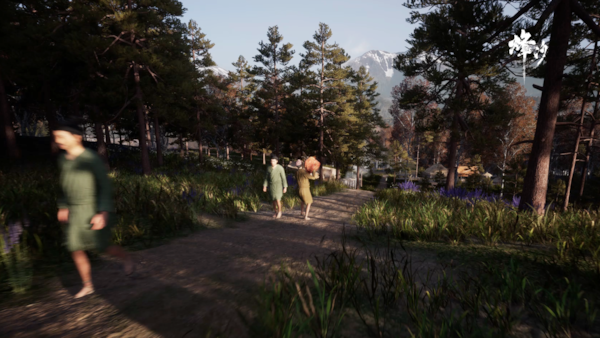
Population is organized around the “Wu,” a small labor unit representing roughly five workers. These workers gather wood and stone, carry resources, construct buildings, farm fields, and operate production buildings. Players do not control every worker manually, but they need to assign labor through buildings and make sure the city has enough workers to handle its daily tasks.
Workers also have needs. Food, water, housing, fuel, and surplus reserves affect public morale. If morale is high, new Wu can join the settlement. If morale drops, population growth may slow, workers may leave, and internal stability can become a problem.
This makes expansion a practical risk. Adding more people gives the city more labor, but it also increases demand for food, water, housing, and fuel. If the city grows faster than its production systems, it can become fragile before the first enemy army appears.
Farming Sets the Pace of Growth
Farming is one of the first systems players need to understand.
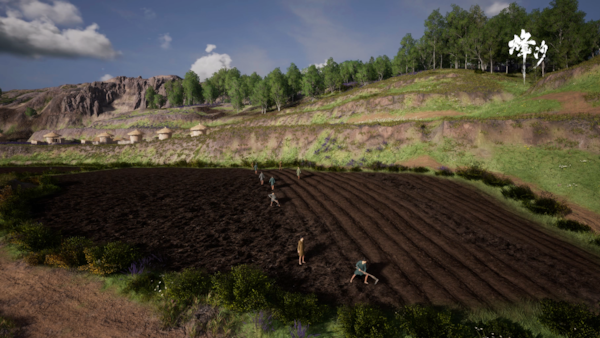
Fields in Mandate Order are not passive background buildings. Players need to open farmland, assign workers, and manage cultivation, sowing, watering, maintenance, and harvest. Food production depends on labor and planning, and it is affected by the broader seasonal rhythm of the game.
The game includes fertility-related mechanics, so farmland cannot be treated as an infinite food machine. Repeated cultivation and land conditions influence output, which means players need to think beyond the current food count. A city that looks stable in spring may still face shortages later if it expands too quickly or fails to prepare enough reserves.
Seasons also matter. Spring plowing, summer tending, autumn harvest, and winter storage are part of the city’s long-term survival loop. Before winter, players need to think about both food and fuel. If reserves are not prepared, morale and productivity may fall.
Farming connects directly to war because it supports the labor force. If players conscript too many workers too early, farms and workshops may slow down. If food reserves are weak, the city may not be able to sustain prolonged military pressure. A larger army may solve one battlefield problem while creating several settlement problems behind the walls.
Resources Have to Move Before They Matter
Mandate Order’s economy is built around physical resource movement rather than a simple global stockpile.
The game includes materials and goods such as logs, stone, clay, ore, grain, fuel, weapons, shields, armor, medicine, chariots, ballista carts, and catapults. These resources must be gathered, carried, processed, stored, and delivered to the buildings that need them.
This means having a resource somewhere in the settlement does not automatically mean it is available.
A construction site may be waiting because timber has not been delivered. A workshop may stop because ore has not arrived. Food may exist, but workers may still waste time hauling it from the wrong place. A weapon may have been produced, but if it has not reached the armory, it cannot support conscription.
Storage and logistics therefore become core parts of the city-building loop. Players build granaries, fuel storage, armories, and general warehouses to organize different types of goods. Placement matters. A warehouse near a resource point may speed up gathering, while one near workshops may support production more efficiently.
As the settlement expands, players can use freight stations and courier posts to manage longer-distance transport.
Freight stations allow players to set local supply and remote demand. For example, a station near a mining area can supply ore, while another station closer to the main city can demand it. Once conditions are met, transport is arranged between them.
Courier posts improve hauling capacity. Workers assigned to courier posts prioritize transport tasks and can move more goods than regular workers. For a growing fortress settlement, this can become the difference between a functioning economy and a city full of stalled production buildings.
Armories Turn Production Into Military Power
Mandate Order’s military system is closely tied to its economy.
To raise soldiers, players need eligible workers and the right equipment. Weapons such as swords, polearms, bows, shields, and armor must be produced and stored in the armory before workers can be properly conscripted into specific troop types.
The armory is therefore not just another storage building. It is a key link between the city’s production system and its military capacity.
If the armory does not contain the required weapons, workers cannot become the corresponding soldiers. If weapons are still in transit or lying in resource piles instead of being stored correctly, conscription can be delayed or limited. If the production chain for weapons breaks down, the city’s ability to reinforce its army suffers.
Conscription also removes labor from the civilian economy. A worker who becomes a soldier no longer gathers wood, carries materials, farms fields, builds structures, or operates workshops. Raising an army gives the player military strength, but it also pulls labor out of the city’s daily operations.
This creates a clear trade-off. Conscript too early, and farms, workshops, and transport may slow down. Conscript too late, and the city may not have enough soldiers when enemies arrive. Build weapons too slowly, and population alone will not become military power.
Walls Are a Spatial System, Not Just a Defensive Number
Once the city can feed its people and produce equipment, players still need to design a defense.
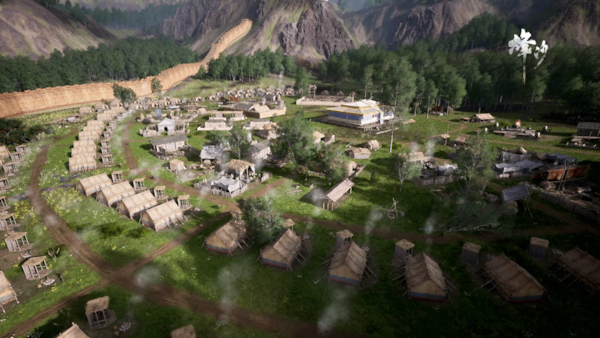
Mandate Order lets players plan walls, gates, towers, and defensive structures. Walls are not decorative edges around the settlement. They are functional military structures that affect how a siege plays out.
Soldiers can be stationed on walls. Archers can use elevated positions to attack enemies below. Defensive equipment such as ballistae can be placed to cover key routes. Gate placement, wall layout, tower positions, and internal roads all influence how well the city can respond to an attack.
A poorly placed gate can expose the city interior. Bad roads can slow soldiers moving from barracks to the wall. A weakly covered approach can let enemies pressure one part of the defense. A breach in the wall can turn the city’s internal layout into part of the battlefield.
Elevation also affects combat. Defenders on walls gain a tactical advantage over attackers fighting from below, while ground troops attacking upward face a more difficult situation.
This makes fortification planning part of the city-building process long before a battle begins. The player is not just deciding where a wall looks good; they are deciding how soldiers will move, where enemies will gather, and which parts of the settlement can survive pressure.
Line-Drawing Formations Make Battles More Readable
Mandate Order includes active battlefield control rather than leaving combat entirely to automated defense.
Players can command units such as polearm soldiers, shield troops, archers, and chariots, as well as siege and defensive equipment like ballista carts and catapults. They can defend their settlement, attack enemy camps, and fight for control of resources.
To make large-scale battles easier to manage, the game uses a line-drawing formation system. After selecting units, players can hold the right mouse button and draw a line on the battlefield. Units then move and deploy according to that shape.
Multiple units can move together in formation and then spread into the drawn line near the destination. This allows players to arrange a front line without relying entirely on rapid individual clicks.
Shield units can hold the front. Archers can fire from behind or from walls. Polearm troops can engage in melee. Chariots can look for opportunities to charge and disrupt enemy formations.
Chariots are one of Mandate Order’s more distinctive battlefield elements. They emphasize impact, suppression, and formation disruption, giving battles a stronger Warring States identity rather than relying only on infantry clashes.
However, battlefield control is only one part of the system. The number and quality of troops available in combat depend on whether the city prepared enough workers, weapons, storage, logistics, and food beforehand.

The City Is the War Machine
Mandate Order’s central idea is not simply that it mixes city-building with battles. It is that the city itself becomes the source of military power.
Fields produce food. Food supports morale. Morale affects population growth. Population provides workers. Workers gather, build, farm, produce, and transport. Logistics moves goods into workshops and storage. Workshops create weapons. Armories store equipment. Workers become soldiers through conscription. Walls and defensive structures shape sieges. Line-drawing formations let players command troops in battle.
These systems connect into one question: can the city actually support war?
That is where Mandate Order distinguishes itself from a city-builder that simply adds combat as a separate feature. The game asks players to build a settlement that can feed itself, organize labor, move goods, produce weapons, defend its walls, and turn civilian life into military capacity when pressure arrives.
For players interested in city-building, resource management, ancient warfare, and systemic strategy, Mandate Order’s appeal may be less about immediate combat and more about everything required before combat becomes possible.
Players are not just building an ancient city. They are building a city that has to work under the pressure of war.
About Mandate Order
Mandate Order is an ancient Chinese war city-builder developed by Digital Sky, an independent studio based in Chengdu, China. Set during the Spring and Autumn and Warring States era, the game starts players with a small frontier settlement and asks them to develop it into a functioning military stronghold. Players will build homes, wells, fields, warehouses, workshops, barracks, armories, walls, and defensive structures, while managing resources, population needs, logistics, retainers, diplomacy, and battlefield tactics. Rather than treating war as a separate combat layer, Mandate Order connects warfare to the full operation of the city — from food production and supply chains to conscription, fortification, and formation-based battles. The game is currently listed on Steam, supports 12 languages, and is planned for a Q3 2026 launch window.
Steam
Official X
Official website
Developed by Digital Sky, Mandate Order is an ancient Chinese war city-builder set during the Spring and Autumn and Warring States era. Players begin with a small frontier settlement and gradually build it into a military stronghold, managing homes, wells, fields, warehouses, workshops, barracks, armories, walls, defensive structures, logistics, retainers, diplomacy, and battlefield formations.
The game is currently listed on Steam, with the team planning to move toward its launch window in Q3 2026.
At first glance, Mandate Order has many familiar elements of a settlement-building game. Players gather resources, place buildings, expand roads, grow food, and keep the population alive. But the game’s systems are designed to push those basic city-building decisions toward war. Food production affects labor. Labor affects construction and logistics. Logistics affects weapon production. Weapons stored in the armory affect conscription. Fortifications affect siege defense. The army is not separate from the city; it is produced by it.
The Settlement Starts With Workers, Not Soldiers
Mandate Order does not start players with a complete town or a standing army. The early game is about making a fragile settlement function.
Players need to build homes for laborers, wells for water, fields for food, warehouses for storage, and workshops for processing materials. Roads connect the settlement’s production areas, residential areas, and resource points. Barracks and armories come later as the city begins preparing for military action.
Population is organized around the “Wu,” a small labor unit representing roughly five workers. These workers gather wood and stone, carry resources, construct buildings, farm fields, and operate production buildings. Players do not control every worker manually, but they need to assign labor through buildings and make sure the city has enough workers to handle its daily tasks.
Workers also have needs. Food, water, housing, fuel, and surplus reserves affect public morale. If morale is high, new Wu can join the settlement. If morale drops, population growth may slow, workers may leave, and internal stability can become a problem.
This makes expansion a practical risk. Adding more people gives the city more labor, but it also increases demand for food, water, housing, and fuel. If the city grows faster than its production systems, it can become fragile before the first enemy army appears.
Farming Sets the Pace of Growth
Farming is one of the first systems players need to understand.
Fields in Mandate Order are not passive background buildings. Players need to open farmland, assign workers, and manage cultivation, sowing, watering, maintenance, and harvest. Food production depends on labor and planning, and it is affected by the broader seasonal rhythm of the game.
The game includes fertility-related mechanics, so farmland cannot be treated as an infinite food machine. Repeated cultivation and land conditions influence output, which means players need to think beyond the current food count. A city that looks stable in spring may still face shortages later if it expands too quickly or fails to prepare enough reserves.
Seasons also matter. Spring plowing, summer tending, autumn harvest, and winter storage are part of the city’s long-term survival loop. Before winter, players need to think about both food and fuel. If reserves are not prepared, morale and productivity may fall.
Farming connects directly to war because it supports the labor force. If players conscript too many workers too early, farms and workshops may slow down. If food reserves are weak, the city may not be able to sustain prolonged military pressure. A larger army may solve one battlefield problem while creating several settlement problems behind the walls.
Resources Have to Move Before They Matter
Mandate Order’s economy is built around physical resource movement rather than a simple global stockpile.
The game includes materials and goods such as logs, stone, clay, ore, grain, fuel, weapons, shields, armor, medicine, chariots, ballista carts, and catapults. These resources must be gathered, carried, processed, stored, and delivered to the buildings that need them.
This means having a resource somewhere in the settlement does not automatically mean it is available.
A construction site may be waiting because timber has not been delivered. A workshop may stop because ore has not arrived. Food may exist, but workers may still waste time hauling it from the wrong place. A weapon may have been produced, but if it has not reached the armory, it cannot support conscription.
Storage and logistics therefore become core parts of the city-building loop. Players build granaries, fuel storage, armories, and general warehouses to organize different types of goods. Placement matters. A warehouse near a resource point may speed up gathering, while one near workshops may support production more efficiently.
As the settlement expands, players can use freight stations and courier posts to manage longer-distance transport.
Freight stations allow players to set local supply and remote demand. For example, a station near a mining area can supply ore, while another station closer to the main city can demand it. Once conditions are met, transport is arranged between them.
Courier posts improve hauling capacity. Workers assigned to courier posts prioritize transport tasks and can move more goods than regular workers. For a growing fortress settlement, this can become the difference between a functioning economy and a city full of stalled production buildings.
Armories Turn Production Into Military Power
Mandate Order’s military system is closely tied to its economy.
To raise soldiers, players need eligible workers and the right equipment. Weapons such as swords, polearms, bows, shields, and armor must be produced and stored in the armory before workers can be properly conscripted into specific troop types.
The armory is therefore not just another storage building. It is a key link between the city’s production system and its military capacity.
If the armory does not contain the required weapons, workers cannot become the corresponding soldiers. If weapons are still in transit or lying in resource piles instead of being stored correctly, conscription can be delayed or limited. If the production chain for weapons breaks down, the city’s ability to reinforce its army suffers.
Conscription also removes labor from the civilian economy. A worker who becomes a soldier no longer gathers wood, carries materials, farms fields, builds structures, or operates workshops. Raising an army gives the player military strength, but it also pulls labor out of the city’s daily operations.
This creates a clear trade-off. Conscript too early, and farms, workshops, and transport may slow down. Conscript too late, and the city may not have enough soldiers when enemies arrive. Build weapons too slowly, and population alone will not become military power.
Walls Are a Spatial System, Not Just a Defensive Number
Once the city can feed its people and produce equipment, players still need to design a defense.
Mandate Order lets players plan walls, gates, towers, and defensive structures. Walls are not decorative edges around the settlement. They are functional military structures that affect how a siege plays out.
Soldiers can be stationed on walls. Archers can use elevated positions to attack enemies below. Defensive equipment such as ballistae can be placed to cover key routes. Gate placement, wall layout, tower positions, and internal roads all influence how well the city can respond to an attack.
A poorly placed gate can expose the city interior. Bad roads can slow soldiers moving from barracks to the wall. A weakly covered approach can let enemies pressure one part of the defense. A breach in the wall can turn the city’s internal layout into part of the battlefield.
Elevation also affects combat. Defenders on walls gain a tactical advantage over attackers fighting from below, while ground troops attacking upward face a more difficult situation.
This makes fortification planning part of the city-building process long before a battle begins. The player is not just deciding where a wall looks good; they are deciding how soldiers will move, where enemies will gather, and which parts of the settlement can survive pressure.
Line-Drawing Formations Make Battles More Readable
Mandate Order includes active battlefield control rather than leaving combat entirely to automated defense.
Players can command units such as polearm soldiers, shield troops, archers, and chariots, as well as siege and defensive equipment like ballista carts and catapults. They can defend their settlement, attack enemy camps, and fight for control of resources.
To make large-scale battles easier to manage, the game uses a line-drawing formation system. After selecting units, players can hold the right mouse button and draw a line on the battlefield. Units then move and deploy according to that shape.
Multiple units can move together in formation and then spread into the drawn line near the destination. This allows players to arrange a front line without relying entirely on rapid individual clicks.
Shield units can hold the front. Archers can fire from behind or from walls. Polearm troops can engage in melee. Chariots can look for opportunities to charge and disrupt enemy formations.
Chariots are one of Mandate Order’s more distinctive battlefield elements. They emphasize impact, suppression, and formation disruption, giving battles a stronger Warring States identity rather than relying only on infantry clashes.
However, battlefield control is only one part of the system. The number and quality of troops available in combat depend on whether the city prepared enough workers, weapons, storage, logistics, and food beforehand.
The City Is the War Machine
Mandate Order’s central idea is not simply that it mixes city-building with battles. It is that the city itself becomes the source of military power.
Fields produce food. Food supports morale. Morale affects population growth. Population provides workers. Workers gather, build, farm, produce, and transport. Logistics moves goods into workshops and storage. Workshops create weapons. Armories store equipment. Workers become soldiers through conscription. Walls and defensive structures shape sieges. Line-drawing formations let players command troops in battle.
These systems connect into one question: can the city actually support war?
That is where Mandate Order distinguishes itself from a city-builder that simply adds combat as a separate feature. The game asks players to build a settlement that can feed itself, organize labor, move goods, produce weapons, defend its walls, and turn civilian life into military capacity when pressure arrives.
For players interested in city-building, resource management, ancient warfare, and systemic strategy, Mandate Order’s appeal may be less about immediate combat and more about everything required before combat becomes possible.
Players are not just building an ancient city. They are building a city that has to work under the pressure of war.
About Mandate Order
Mandate Order is an ancient Chinese war city-builder developed by Digital Sky, an independent studio based in Chengdu, China. Set during the Spring and Autumn and Warring States era, the game starts players with a small frontier settlement and asks them to develop it into a functioning military stronghold. Players will build homes, wells, fields, warehouses, workshops, barracks, armories, walls, and defensive structures, while managing resources, population needs, logistics, retainers, diplomacy, and battlefield tactics. Rather than treating war as a separate combat layer, Mandate Order connects warfare to the full operation of the city — from food production and supply chains to conscription, fortification, and formation-based battles. The game is currently listed on Steam, supports 12 languages, and is planned for a Q3 2026 launch window.
Steam
Official X
Official website