As a city grows more complex, players may not need more systems so much as confidence that the game will carry out their decisions correctly.
Manor Lords recently released its seventh major update.
Rather than leading with a new map, new buildings, or new unit types, the update focused on major revisions to pathfinding, collision, character movement, group commands, and task behavior. Troops now adjust their formations depending on whether they are moving through open ground, roads, or dense building areas. The game has also added a system for identifying enclosed and disconnected zones, while addressing a wide range of issues involving stuck workers, handcart transport, warehouse tasks, building entrances, and army movement.
These changes may sound highly technical, but they touch on one of the most important needs players have in simulation and strategy games:
As systems become more complex, can players still understand what is happening—and trust the game to execute their decisions correctly?
Players Can Accept Failure. They Cannot Accept Not Knowing Why They Failed
In a simulation strategy game, even a seemingly simple command often depends on a long chain of execution.
A player decides to construct a workshop. The materials must first be taken from storage. Workers must find a valid route. Resources must be delivered to the construction site. Once completed, the building still needs labor, raw materials, storage, and transport in order to operate.
If any part of that chain breaks down, the only result the player may see is:
The building is not working.
What the player actually needs to determine is why.
Is there not enough labor?
Are materials missing?
Is the warehouse too far away?
Has the task been given the wrong priority?
Or has pathfinding failed?
The appeal of strategy games is built on cause and effect.
A city should prosper because the player planned well. A city should fall into crisis because of a poor decision or a risk the player knowingly accepted. If the underlying simulation cannot execute commands consistently, the player is no longer analyzing the city.
They are trying to guess what the game is doing.
That is why the core of this Manor Lords update is not simply faster pathfinding. It is an attempt to rebuild the player’s trust in the simulation.
Different Strategy Games Are All Trying to Make Complexity Controllable
Strategy games need depth, but depth does not simply mean adding more buttons, resources, and numerical systems.
What matters is that systems can be complex while still allowing players to identify the problem and understand how they can intervene.
Different games have developed several common approaches.
One is greater information transparency. Survival city-builders such as Frostpunk clearly display food, temperature, illness, and citizen needs, allowing players to see where a crisis began, who it is affecting, and how much time remains before it becomes unmanageable.
Another approach is to turn micromanagement into priority management. RimWorld and many colony simulators do not require players to control every character directly. Instead, players establish work priorities, production rules, and storage restrictions, while the simulation carries out the individual tasks.
A third approach is to create reliable spatial rules. Manor Lords’ latest revisions to roads, bridges, castles, building entrances, and troop formations are designed to make outcomes more predictable: how workers move, whether carts can pass through a route, and what happens when an army enters a different kind of space.
These approaches address problems of information, scale, and space.
Another group of war-focused city-builders takes a different route: using a shared external pressure to connect systems that might otherwise remain separate.
Mandate Order’s Approach: Making War a Problem for the Entire City
Mandate Order, developed by Chengdu-based independent studio Digital Sky, offers a useful case study.
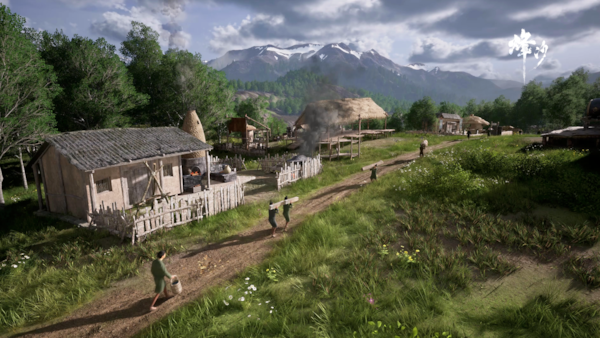
Set during ancient China’s Spring and Autumn and Warring States era, Mandate Order is a war city-building simulation planned for release on Steam in Q3 2026. Like Manor Lords, it combines freeform construction, working populations, resource transport, and large-scale battles, which is why it is often discussed within the broader category of games that bring city-building and warfare together.
What makes Mandate Order especially relevant here, however, is its attempt to prevent war from becoming a separate mode that begins only after city-building is complete.
The game uses the Wu as its basic unit of population and labor, with each Wu representing roughly five workers. These workers farm, gather, haul, construct, and produce. Buildings also require assigned Wu in order to remain operational.
When the player conscripts soldiers, they are not simply reducing an abstract population number.
They are removing the people who were keeping the city alive.
Once a rally point is confirmed, workers immediately stop their current tasks. Any resources they were carrying are left where they were. The conscription system offers two priority options: “Fastest,” which selects people closer to the armory, and “Lowest Work Impact,” which attempts to reduce disruption to the city’s economy.
Conscription is therefore no longer just a button that increases military strength.
It becomes a clear trade-off:
Is it more important to form an army immediately, or to keep the farms, workshops, and transport network running?
Equipment follows the same logic.
Producing weapons does not mean those weapons can immediately be used for conscription. Only equipment that has actually been stored in the armory is counted. Weapons still in transit, or goods left in piles on the ground, cannot be converted directly into military power.
A single weapon must therefore pass through mining, fuel supply, smelting, production, transport, and storage before it can become part of an army.
Gathering, manufacturing, logistics, population, and warfare are no longer parallel features. They all answer the same question:
When the enemy arrives, can the city turn its earlier preparations into actual military strength?
Recent revisions to Mandate Order’s invasion system reinforce this relationship. Bandits may demand currency or resources from the player. The player can surrender those goods to avoid immediate conflict, or refuse and risk attacks against valuable storage buildings.
Handing over resources slows development. Refusing means preparing soldiers, equipment, and defenses in advance.
Either way, war enters agriculture, production, storage, and labor allocation before the first battle begins.

Complex Systems Do Not Need to Be Removed. They Need Better Feedback
Manor Lords and Mandate Order are taking different approaches, but both are responding to the same underlying problem.
Players are not necessarily opposed to complexity.
What they dislike is not knowing why a system failed to behave as expected.
If a workshop stops producing, the game should explain what it is missing.
If a worker becomes stuck, the player should be able to see what is blocking the task.
If an army cannot reach its destination, the player should understand whether the problem is caused by roads, formations, or terrain.
If conscription disrupts production, the player should be able to see which jobs have lost their workers.
Feedback around logistics, storage, and resource movement has also been one of the more difficult areas for players to understand in Mandate Order. The team is continuing to revise tutorials, information displays, resource search tools, and system feedback. The goal is not to remove the relationships between logistics and production, but to make it easier for players to understand where a resource is, why it has not arrived, and what the city is actually missing.
That ultimately leads to the same conclusion as Manor Lords’ revisions to pathfinding, task queues, and group movement:
Systems can be complex, but their outcomes must remain explainable.
Strategy players can accept losing part of a city because of a bad decision. They can accept war interrupting long-term development.
But only if they can be certain that the outcome came from their own judgment—not because the simulation failed to carry out their orders.
What strategy games ultimately need to build is not merely a world filled with many interconnected mechanics.
They need to build a clear, reliable, and trustworthy chain of cause and effect between the player and that world.
About Mandate Order
Mandate Order is an ancient Chinese war city-builder developed by Digital Sky, an independent studio based in Chengdu, China. Set during the Spring and Autumn and Warring States era, the game starts players with a small frontier settlement and asks them to develop it into a functioning military stronghold. Players build homes, wells, fields, warehouses, workshops, barracks, armories, walls, and defensive structures while managing resources, population needs, logistics, retainers, diplomacy, and battlefield tactics. The game is currently listed on Steam, supports 12 languages, and is planned for a Q3 2026 launch window.
Steam
Official X
Official website
Manor Lords recently released its seventh major update.
Rather than leading with a new map, new buildings, or new unit types, the update focused on major revisions to pathfinding, collision, character movement, group commands, and task behavior. Troops now adjust their formations depending on whether they are moving through open ground, roads, or dense building areas. The game has also added a system for identifying enclosed and disconnected zones, while addressing a wide range of issues involving stuck workers, handcart transport, warehouse tasks, building entrances, and army movement.
These changes may sound highly technical, but they touch on one of the most important needs players have in simulation and strategy games:
As systems become more complex, can players still understand what is happening—and trust the game to execute their decisions correctly?
Players Can Accept Failure. They Cannot Accept Not Knowing Why They Failed
In a simulation strategy game, even a seemingly simple command often depends on a long chain of execution.
A player decides to construct a workshop. The materials must first be taken from storage. Workers must find a valid route. Resources must be delivered to the construction site. Once completed, the building still needs labor, raw materials, storage, and transport in order to operate.
If any part of that chain breaks down, the only result the player may see is:
The building is not working.
What the player actually needs to determine is why.
Is there not enough labor?
Are materials missing?
Is the warehouse too far away?
Has the task been given the wrong priority?
Or has pathfinding failed?
The appeal of strategy games is built on cause and effect.
A city should prosper because the player planned well. A city should fall into crisis because of a poor decision or a risk the player knowingly accepted. If the underlying simulation cannot execute commands consistently, the player is no longer analyzing the city.
They are trying to guess what the game is doing.
That is why the core of this Manor Lords update is not simply faster pathfinding. It is an attempt to rebuild the player’s trust in the simulation.
Different Strategy Games Are All Trying to Make Complexity Controllable
Strategy games need depth, but depth does not simply mean adding more buttons, resources, and numerical systems.
What matters is that systems can be complex while still allowing players to identify the problem and understand how they can intervene.
Different games have developed several common approaches.
One is greater information transparency. Survival city-builders such as Frostpunk clearly display food, temperature, illness, and citizen needs, allowing players to see where a crisis began, who it is affecting, and how much time remains before it becomes unmanageable.
Another approach is to turn micromanagement into priority management. RimWorld and many colony simulators do not require players to control every character directly. Instead, players establish work priorities, production rules, and storage restrictions, while the simulation carries out the individual tasks.
A third approach is to create reliable spatial rules. Manor Lords’ latest revisions to roads, bridges, castles, building entrances, and troop formations are designed to make outcomes more predictable: how workers move, whether carts can pass through a route, and what happens when an army enters a different kind of space.
These approaches address problems of information, scale, and space.
Another group of war-focused city-builders takes a different route: using a shared external pressure to connect systems that might otherwise remain separate.
Mandate Order’s Approach: Making War a Problem for the Entire City
Mandate Order, developed by Chengdu-based independent studio Digital Sky, offers a useful case study.
Set during ancient China’s Spring and Autumn and Warring States era, Mandate Order is a war city-building simulation planned for release on Steam in Q3 2026. Like Manor Lords, it combines freeform construction, working populations, resource transport, and large-scale battles, which is why it is often discussed within the broader category of games that bring city-building and warfare together.
What makes Mandate Order especially relevant here, however, is its attempt to prevent war from becoming a separate mode that begins only after city-building is complete.
The game uses the Wu as its basic unit of population and labor, with each Wu representing roughly five workers. These workers farm, gather, haul, construct, and produce. Buildings also require assigned Wu in order to remain operational.
When the player conscripts soldiers, they are not simply reducing an abstract population number.
They are removing the people who were keeping the city alive.
Once a rally point is confirmed, workers immediately stop their current tasks. Any resources they were carrying are left where they were. The conscription system offers two priority options: “Fastest,” which selects people closer to the armory, and “Lowest Work Impact,” which attempts to reduce disruption to the city’s economy.
Conscription is therefore no longer just a button that increases military strength.
It becomes a clear trade-off:
Is it more important to form an army immediately, or to keep the farms, workshops, and transport network running?
Equipment follows the same logic.
Producing weapons does not mean those weapons can immediately be used for conscription. Only equipment that has actually been stored in the armory is counted. Weapons still in transit, or goods left in piles on the ground, cannot be converted directly into military power.
A single weapon must therefore pass through mining, fuel supply, smelting, production, transport, and storage before it can become part of an army.
Gathering, manufacturing, logistics, population, and warfare are no longer parallel features. They all answer the same question:
When the enemy arrives, can the city turn its earlier preparations into actual military strength?
Recent revisions to Mandate Order’s invasion system reinforce this relationship. Bandits may demand currency or resources from the player. The player can surrender those goods to avoid immediate conflict, or refuse and risk attacks against valuable storage buildings.
Handing over resources slows development. Refusing means preparing soldiers, equipment, and defenses in advance.
Either way, war enters agriculture, production, storage, and labor allocation before the first battle begins.
Complex Systems Do Not Need to Be Removed. They Need Better Feedback
Manor Lords and Mandate Order are taking different approaches, but both are responding to the same underlying problem.
Players are not necessarily opposed to complexity.
What they dislike is not knowing why a system failed to behave as expected.
If a workshop stops producing, the game should explain what it is missing.
If a worker becomes stuck, the player should be able to see what is blocking the task.
If an army cannot reach its destination, the player should understand whether the problem is caused by roads, formations, or terrain.
If conscription disrupts production, the player should be able to see which jobs have lost their workers.
Feedback around logistics, storage, and resource movement has also been one of the more difficult areas for players to understand in Mandate Order. The team is continuing to revise tutorials, information displays, resource search tools, and system feedback. The goal is not to remove the relationships between logistics and production, but to make it easier for players to understand where a resource is, why it has not arrived, and what the city is actually missing.
That ultimately leads to the same conclusion as Manor Lords’ revisions to pathfinding, task queues, and group movement:
Systems can be complex, but their outcomes must remain explainable.
Strategy players can accept losing part of a city because of a bad decision. They can accept war interrupting long-term development.
But only if they can be certain that the outcome came from their own judgment—not because the simulation failed to carry out their orders.
What strategy games ultimately need to build is not merely a world filled with many interconnected mechanics.
They need to build a clear, reliable, and trustworthy chain of cause and effect between the player and that world.
About Mandate Order
Mandate Order is an ancient Chinese war city-builder developed by Digital Sky, an independent studio based in Chengdu, China. Set during the Spring and Autumn and Warring States era, the game starts players with a small frontier settlement and asks them to develop it into a functioning military stronghold. Players build homes, wells, fields, warehouses, workshops, barracks, armories, walls, and defensive structures while managing resources, population needs, logistics, retainers, diplomacy, and battlefield tactics. The game is currently listed on Steam, supports 12 languages, and is planned for a Q3 2026 launch window.
Steam
Official X
Official website